

Elon Musk just closed the largest private acquisition in history—and it’s not about rockets or AI. It’s about escaping Earth’s power grid to win the infrastructure war.
The Deal: What Actually Happened
On February 2, 2026, SpaceX officially acquired xAI for $250 billion in an all-stock transaction, creating a $1.25 trillion vertically integrated entity that combines launch capabilities, satellite infrastructure, social media distribution, and frontier AI models under a single corporate roof. This is the largest private target acquisition ever recorded—exceeding the Dell-EMC merger by nearly four times.
The combined entity now controls SpaceX’s rocket and Starlink operations (valued at approximately $800 billion following their late-2025 funding round), xAI’s Grok models and compute infrastructure, and the X platform (formerly Twitter), which xAI had previously absorbed. Sullivan & Cromwell, advising xAI on the transaction, described it as “the most ambitious, vertically-integrated innovation engine on Earth.”
The deal structure reveals the underlying financial engineering. xAI investors receive SpaceX stock, providing them liquidity ahead of SpaceX’s planned mid-2026 IPO targeting approximately $50 billion in capital raise. xAI had just closed a $20 billion Series E in January 2026, establishing its $250 billion valuation floor. The all-stock nature means no immediate cash outlay while still providing xAI shareholders a path to public market liquidity within months.
Follow the Power: The Real Strategic Rationale
The headline talks about AI and rockets. The actual strategy is about electricity.
xAI’s current burn rate sits at $1 billion per month—predominantly compute costs. That’s $12 billion annually just to keep the lights on and the GPUs humming. Meanwhile, training runs for frontier models now require power allocations that compete with small cities. OpenAI, Anthropic, Google, and Microsoft are all locked in bidding wars for data center capacity and grid access. Some training clusters are being sited based purely on proximity to power generation, not network latency or labor costs.
SpaceX’s response: remove the grid from the equation entirely.
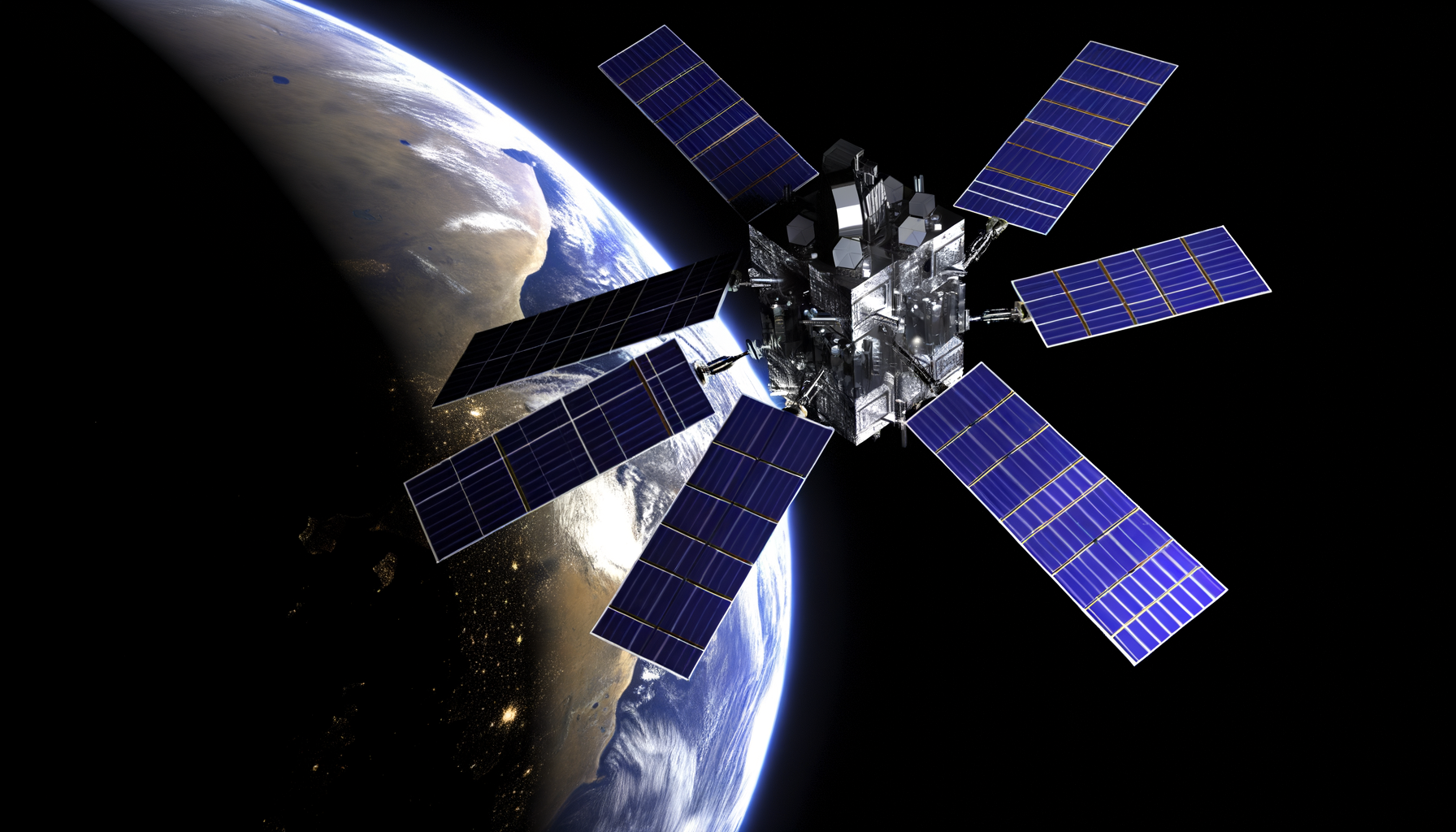
The stated plan calls for orbital AI data centers powered by up to one million satellites generating 100 gigawatts of solar-powered compute. For context, the entire United States consumed approximately 450 gigawatts on average in 2025. SpaceX is proposing to build roughly 22% of American electricity consumption as dedicated AI compute capacity, floating above the atmosphere where solar collection is 40% more efficient than terrestrial installations and cooling is effectively free.
This isn’t science fiction dressed up as strategy. Starlink already operates over 6,000 satellites with demonstrated mass manufacturing capabilities. SpaceX launched more mass to orbit in 2025 than all other launch providers combined. Starship’s payload economics—potentially under $100 per kilogram to low Earth orbit at full reusability—make the unit economics of orbital infrastructure fundamentally different than even five years ago.
“SpaceX is positioning itself as an existential competitor to traditional hyperscalers,” noted Futurum Group in their analysis. This is precise language: not “competitor,” but “existential competitor.”
The Vertical Integration Stack
Understanding what SpaceX-xAI actually controls requires walking through each layer:
Layer 1: Launch and Orbital Access
SpaceX owns the cheapest, most frequent access to orbit on the planet. No competitor comes close. United Launch Alliance, Rocket Lab, Blue Origin, and various national space agencies combined launched fewer payloads than SpaceX alone in 2025. This isn’t a lead; it’s a monopoly position masked by the existence of nominal competition.
Starship’s full reusability, once operational at scale, drops the cost curve by another order of magnitude. When your cost to deploy one kilogram of compute hardware to orbit falls below your cost to acquire urban real estate and build terrestrial data center infrastructure, the calculus of where to locate compute changes fundamentally.
Layer 2: Satellite Manufacturing at Scale
Starlink proved that SpaceX can manufacture thousands of sophisticated satellites annually with consistent quality. The production line that builds communication satellites can be retooled for compute satellites. FCC regulations require satellite replacement every five years, which sounds like a liability until you realize it creates recurring Starship launch revenue—SpaceX paying itself to maintain infrastructure SpaceX owns.
The manufacturing expertise transfers directly. A compute-optimized satellite shares 70-80% of components with a communication satellite: power systems, thermal management, attitude control, propulsion for stationkeeping. The delta is swapping transponders for processing units and storage.
Layer 3: Global Connectivity
Starlink provides the backhaul. Any orbital compute node can communicate with any ground station or with other orbital nodes via laser interlinks. Latency to orbital infrastructure from most populated areas is actually lower than latency to distant terrestrial data centers—light travels faster through vacuum than through fiber.
This solves the “last mile” problem for orbital compute. You don’t need ground stations near your compute; you need ground stations near your users, and Starlink is already deploying those globally for its internet service.
Layer 4: AI Models and Training
xAI brings Grok, currently the third or fourth most capable frontier model depending on benchmark selection. More importantly, xAI brings the team: researchers who understand what future training runs require and can specify the orbital compute architecture needed to support them.
The talent acquisition aspect deserves attention. xAI employed roughly 100 researchers who have now effectively joined SpaceX’s mission. These aren’t just AI engineers; they’re AI engineers who signed up to work on Musk-style ambitious problems. That self-selection filter matters.
Layer 5: Distribution and Data
X platform generated $2.9 billion in revenue in 2025 from advertising and subscriptions, though this comes with $1.2 billion in debt service costs from the original acquisition financing. More valuable than the revenue: X produces training data at scale, provides distribution for AI products, and offers real-time human feedback signals.
Every interaction on X can train Grok. Every Grok output on X generates user feedback. This flywheel has existed conceptually since the xAI acquisition of X; now it’s unified in a single corporate entity that also controls the infrastructure to capitalize on it.
The Financial Engineering
SpaceX generated approximately $8 billion in profit on $15-16 billion in revenue in 2025. That cash flow can absorb xAI’s $1 billion monthly burn—but just barely, and only if xAI’s costs don’t grow. They will grow. Training frontier models at the pace the industry demands requires exponentially increasing compute budgets.
The IPO timing explains the deal structure. SpaceX targets mid-2026 for a public offering seeking ~$50 billion. Going public with xAI already integrated tells a much more compelling growth story than SpaceX alone. Rockets and satellite internet are impressive but linear businesses. “We’re building the AI infrastructure for humanity that doesn’t depend on terrestrial power grids” is a narrative that justifies speculative valuations.
xAI investors accepting SpaceX stock means they believe SpaceX’s public market valuation will exceed the private market valuation implied by this deal. Given that mega-cap tech companies trade at significant premiums to their private market comparables, this is likely correct. xAI investors are trading certainty of a $250 billion private valuation for optionality on a potentially higher public valuation—with the hedge that SpaceX’s core business provides downside protection.
What the Coverage Gets Wrong
Most analysis frames this as a consolidation play—Musk simplifying his corporate structure, reducing conflicts of interest, preparing for public markets. That’s the legal and financial story. It’s also boring and largely irrelevant to the strategic implications.
Wrong take #1: “This is about regulatory simplification.” Musk’s companies have operated with tangled governance for over a decade. The Tesla-SolarCity merger faced derivative litigation that Musk lost, but he paid personally and moved on. Regulatory tidiness has never been a decision-forcing constraint for Musk’s organizations.
Wrong take #2: “Orbital data centers are decades away.” Components exist today. Solar panels, batteries, processors, and cooling systems all fly on existing satellites. The engineering challenge is integration and scale, not fundamental R&D. SpaceX has demonstrated it can scale satellite manufacturing and launch at rates that seemed impossible five years ago. Betting against SpaceX’s execution timeline has been a losing trade consistently.
Wrong take #3: “Hyperscalers will just build their own rockets.” AWS, Azure, and Google Cloud have spent billions on data center infrastructure. None have demonstrated interest or capability in launch vehicle development. The capital allocation and organizational competencies required are entirely different. Amazon’s Project Kuiper, their Starlink competitor, uses third-party launch providers. Building competitive launch capability would take a decade minimum, by which point the market position has already been established.
The underhyped angle: Terrestrial data center operators now face fundamental strategic uncertainty. If orbital compute becomes viable and cost-competitive within 5-7 years, massive investments in terrestrial infrastructure face accelerated depreciation or stranded asset risk. How do you underwrite a 15-year data center investment when the competitive landscape might shift fundamentally in year 7?
Technical Architecture: What Orbital AI Compute Actually Requires
Let’s get concrete about what 100 gigawatts of orbital compute means architecturally.
Power Generation
Current high-efficiency space-rated solar panels achieve roughly 30% conversion efficiency and generate about 300-400 watts per square meter in continuous sunlight. Satellites in low Earth orbit (LEO) experience eclipse periods (Earth’s shadow) for roughly 35% of each orbit, requiring battery storage.
100 gigawatts of continuous compute power requires approximately 150+ gigawatts of peak solar generation capacity to account for eclipse periods, thermal management overhead, and power conversion losses. At 350 watts per square meter, that’s roughly 430 square kilometers of solar panel area—about 8% of Los Angeles’s land area, distributed across potentially hundreds of thousands of satellites.
The number sounds enormous until you calculate: at 100 square meters of panel per satellite, that’s 4.3 million satellite equivalents worth of solar collection area. But satellites can be larger; Starship’s payload fairing allows structures that unfurl to several hundred square meters. The million-satellite figure mentioned in announcements actually provides overhead capacity.
Thermal Management
This is where orbital infrastructure has fundamental advantages. In space, the only heat rejection mechanism is radiation—no convection or conduction to surrounding air. However, the radiative environment at LEO actually favors cooling: objects can radiate to the cosmic background at approximately 3 Kelvin. Properly designed thermal radiators achieve dramatically better performance than terrestrial cooling towers or air conditioning systems.
The engineering challenge is keeping compute components at optimal operating temperature (roughly 60-80°C for most processors) while radiating excess heat to space. This is a solved problem for existing spacecraft—just at smaller scale. The question is whether the thermal architecture scales linearly with compute density.
Compute Hardware
Current AI training clusters use GPUs optimized for dense matrix multiplication (NVIDIA’s H100/H200 series, AMD’s MI300 series). These chips are designed for terrestrial data center environments with specific power delivery, cooling, and interconnect assumptions.
Space-rated compute hardware either requires radiation hardening (which dramatically increases cost and decreases performance) or accepts higher failure rates and designs around them with redundancy. The optimal architecture probably involves commercial-grade chips with aggressive redundancy and error correction, accepting that individual chips will fail more frequently than in terrestrial deployments but designing system-level reliability through replication.
Interconnect bandwidth presents another challenge. Training large language models requires constant communication between distributed compute nodes. Fiber-optic interconnects in terrestrial data centers achieve multi-terabit-per-second bandwidth over short distances. Laser interlinks between satellites currently achieve tens of gigabits per second over hundreds of kilometers—orders of magnitude less bandwidth per connection, though also orders of magnitude less latency than terrestrial alternatives for intercontinental communication.
This constraint suggests orbital compute might first be competitive for inference workloads (which parallelize easily with minimal inter-node communication) rather than training workloads (which require tight coupling between nodes). Training might remain terrestrial while inference migrates to orbit as the first application.
Software and Orchestration
Workload scheduling across an orbital constellation requires new distributed systems primitives. Satellites move relative to ground stations continuously. Eclipse periods reduce available compute capacity predictably but dynamically. Hardware failures happen more frequently than in terrestrial environments.
The orchestration layer must handle:
- Geographic locality—matching workloads to satellites currently positioned for low-latency connection to specific ground stations
- Power-aware scheduling—reducing compute loads during eclipse periods when batteries are discharging
- Fault tolerance—seamlessly migrating workloads when satellites fail or become unreachable
- Thermal management—throttling compute to maintain optimal chip temperatures as solar exposure varies
This is genuinely novel distributed systems territory. Existing orchestrators like Kubernetes or Slurm assume stable, high-bandwidth interconnects and consistent power availability. Orbital infrastructure requires ground-up rethinking of scheduling algorithms and failure handling.
Competitive Response: What AWS, Azure, and Google Cloud Do Now
The hyperscalers face an uncomfortable strategic reality: their core competitive advantages (massive capital, operational expertise, customer relationships) don’t transfer to orbital infrastructure development.
Option 1: Partner with SpaceX. AWS already uses SpaceX launches for Project Kuiper satellites. Extending that relationship to purchase orbital compute capacity from SpaceX-xAI is logical but strategically dangerous. It creates dependency on a competitor and funds their infrastructure buildout.
Option 2: Accelerate terrestrial efficiency. Invest aggressively in power efficiency, nuclear-powered data centers, and distributed compute closer to renewable generation sources. This concedes the orbital opportunity but doubles down on existing competencies.
Option 3: Develop competitive orbital capability. This requires launch vehicle development (decade+ timeline), satellite manufacturing at scale (5+ year capability buildout), and regulatory approval for large constellations (uncertain timeline). The capital required exceeds $100 billion for any credible attempt.
Option 4: Regulatory capture. Lobby for restrictions on orbital compute infrastructure citing debris concerns, spectrum allocation, or national security. This is the most likely near-term response from incumbents who recognize they can’t compete technically.
Expect significant regulatory friction on constellation expansion approvals over the next 3-5 years, with hyperscalers quietly funding opposition research and advocacy through proxy organizations.
What This Means for Your Infrastructure Decisions
If you’re making infrastructure decisions in 2026 with 5+ year horizons, the SpaceX-xAI merger introduces strategic uncertainty you need to price into your planning.
For compute-intensive AI workloads: Signing long-term committed-use contracts with terrestrial cloud providers carries more risk than it did six months ago. Consider shorter commitment windows even if per-unit costs increase. The flexibility premium may prove worthwhile if orbital alternatives become competitive faster than expected.
For latency-sensitive applications: Monitor Starlink’s enterprise services roadmap. Edge compute capabilities integrated with satellite connectivity could provide latency profiles impossible with terrestrial-only infrastructure, particularly for globally distributed users.
For sustainability-focused organizations: Orbital compute may offer genuinely carbon-negative operation—solar power in space with no terrestrial grid dependency. If your organization has aggressive emissions reduction commitments, understand when orbital infrastructure might become part of your sustainability toolkit.
For AI training pipelines: Consider hybrid architectures where data preparation and preprocessing happen terrestrially while inference scales elastically on orbital infrastructure. The latency and bandwidth characteristics favor this division of labor once orbital compute becomes available.
For capacity planning: Traditional forecasting models assume cloud infrastructure pricing continues its historical decline curve driven by semiconductor improvements and economies of scale. A structural shift to orbital infrastructure could accelerate that decline dramatically—or could create a bifurcated market with premium orbital pricing and commoditized terrestrial pricing. Build scenarios for both.
The 12-Month View
By February 2027, we’ll have clearer signal on execution feasibility. Specific milestones to watch:
Q2 2026: SpaceX IPO and market reception. Valuation will indicate whether public investors buy the orbital compute thesis or view it as speculative distraction from the core launch and Starlink businesses.
Q3 2026: First detailed technical specifications for compute-optimized satellites. Expect announcements at SpaceX’s customer conference or a dedicated orbital compute event. These specs will reveal how seriously to take the 100-gigawatt target.
Q4 2026: xAI integration milestones. Does Grok training shift to SpaceX-controlled infrastructure? Does X platform monetization improve with tighter Grok integration? Operational improvements signal whether the merger creates genuine synergies or just paper consolidation.
Q1 2027: Regulatory posture becomes clear. Watch FCC spectrum allocation decisions and orbital debris commentary from international bodies. These early indicators will signal whether orbital compute faces a relatively clear regulatory path or years of permitting friction.
Throughout 2026-2027: Hyperscaler response patterns. Strategic acquisitions (Blue Origin? Rocket Lab?), partnership announcements, and terrestrial infrastructure investment adjustments will reveal how seriously incumbents view the orbital compute threat.
The Strategic Reality
Strip away the headline spectacle and the SpaceX-xAI merger reveals a simple thesis: whoever controls the cheapest, most scalable compute infrastructure wins the AI competition. SpaceX is betting that orbital solar power provides structural cost advantages that no amount of terrestrial optimization can match.
This bet might be wrong. The engineering challenges of orbital compute at scale remain substantial. Regulatory barriers could prove insurmountable. The timeline could slip by decades rather than years.
But if the bet is right—if SpaceX can actually deploy 100 gigawatts of orbital compute capacity before 2035—the competitive implications for cloud infrastructure providers, AI labs, and enterprise technology architecture are transformative. The largest private acquisition in history isn’t about rockets or AI models; it’s about repositioning for an infrastructure competition that hasn’t fully started yet.
The CTOs and founders who understand this aren’t just watching the SpaceX-xAI merger as corporate news—they’re updating their infrastructure strategies to account for a future where the winning cloud provider might not have a single data center on Earth.