


OpenSRE has 15,935 stars, 2,078 forks and an Apache 2.0 licence, which reads like a mature project. It also ships a date-stamped release almost every day and carries a “Public Alpha” banner in its own README.
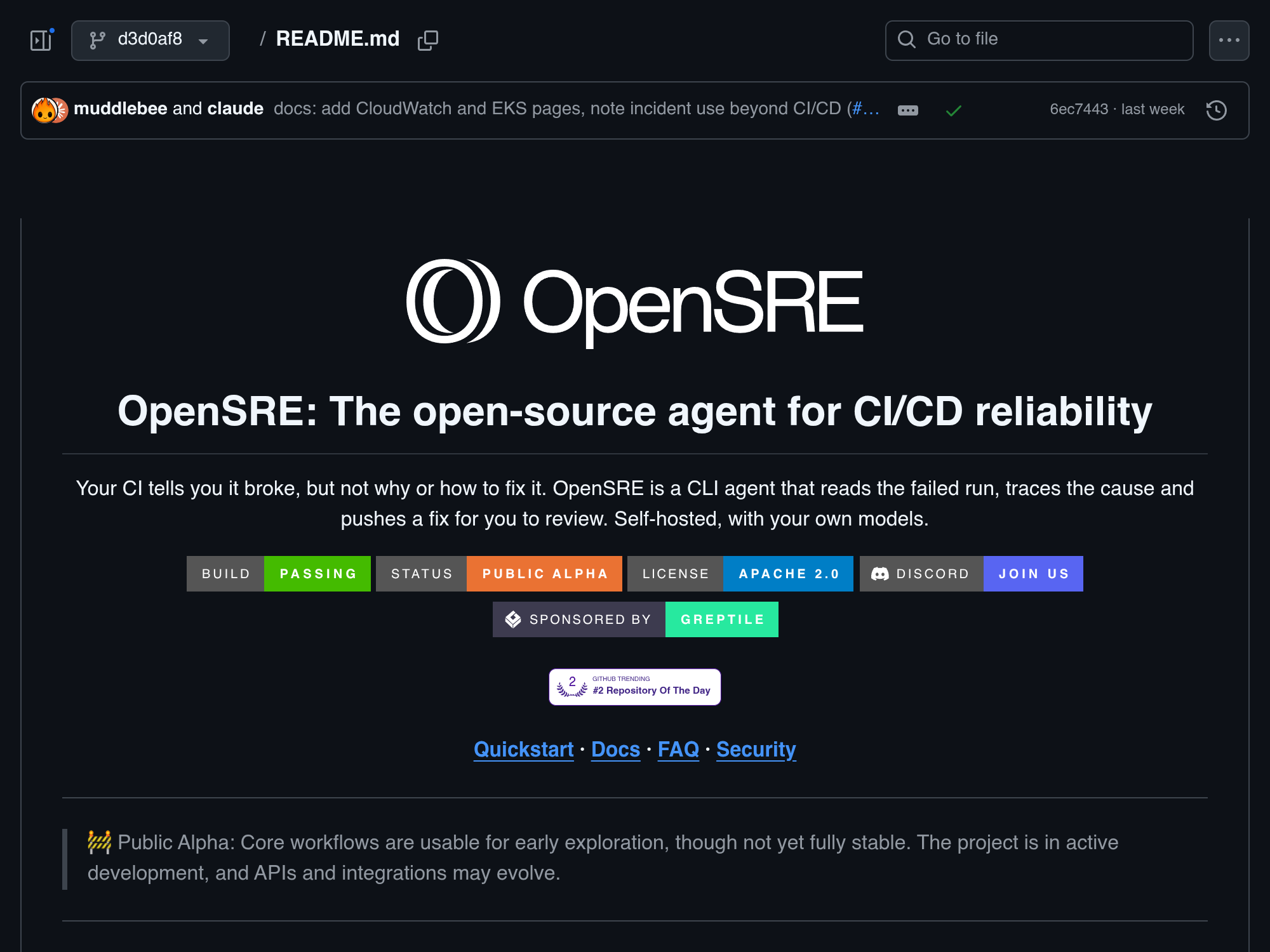
OpenSRE is a CLI agent from Tracer Cloud that reads a failed CI run, traces the cause and pushes a fix to the PR branch for review. The latest tag as of 27 November 2026 is v0.1.2026.11.27; the previous one, v0.1.2026.11.25, landed on 25 November. Nine tags in November, three on consecutive days, and no compatibility signal in any of them.
The tag encodes a calendar date, not a compatibility promise
A semantic version is a promise. Patch means I fixed something and did not move your furniture, minor means I added something you can ignore, major means read the notes or your build breaks. OpenSRE’s scheme encodes major version 0.1 plus a calendar date. v0.1.2026.11.26 and v0.1.2026.11.27 are one day apart, and that is all the tag says about the difference between them.
The difference, read from the release notes themselves, is real. The 26 November build added apply_patch, described in its own changelog as “the edit tool the system prompt already names”, plus file read, search and list operations that run without going through a shell, plus batched tool calls with a prompt cache held across sessions. That changes how the agent touches your repository and how it spends tokens. Then 27 November contains exactly one commit: a scheduler fix so strip_html stops deleting report text. One day, one fix. The day before, four behavioural changes to the agent core.
Under date versioning both look identical from the outside. You cannot tell from the tag whether an upgrade is a typo fix or a new file-mutation path. My read: this is the single largest adoption cost of the project right now, and the maintainers could reverse it without touching a line of agent code.
The catch in the quickstartThe README install command (curl -fsSL https://install.opensre.com | bash -s -- -gh) does not install a release. It “fetches the latest build from main“, per the README. The pinned path is the one printed on each release page: bash -s -- --release --version 0.1.2026.11.25. If you follow the front-page instructions you are running an unpinned rolling binary against your CI credentials.
That distinction matters more than it looks. The releases list also carries a rolling tag, main-build, published as version 0.1.2026.11.26+main.d3d0af8, built 26 November at 08:18 UTC. So three things all call themselves OpenSRE: dated releases, a rolling main build, and whatever the installer pulled when you ran it. Pick one deliberately.
Most of the daily churn is Dependabot, and the features hide inside it
The cadence is not a red flag by itself. Reading the 25 and 26 November changelogs, most of what moves daily is dependency bumps: click 8.5.0 to 8.5.1, boto3 1.43.123 to 1.44.9, pymongo 4.19.0 to 4.20.1, ruff 0.17.4 to 0.17.6, pyyaml, filelock, types-psycopg2, import-linter. A project with Dependabot on a tight schedule and an automated tag-on-merge pipeline will produce exactly this pattern. The 25 November build also tightened CI security by dropping persisted tokens in privileged workflows.
The feature commits are interleaved with the noise. v0.1.2026.11.25 shipped official MCP server presets for Grafana, Datadog, PagerDuty and AWS, and bridged Sentry and PostHog MCP connections into typed, gated agent tools, in the same release as nine dependency bumps. Nothing in the tag or the release title separates the two.
So the cadence tells me the team ships fast with automation in place, which is a good sign about engineering hygiene. It also tells me nobody has decided what a release means for the person consuming it. Both are true here.
The agent loop ends by pushing a fix to the PR branch
The agent is a tool-calling loop with a defined sequence, documented in the README. It fetches the failing checks and CI logs plus recent commits and deploys plus correlated logs, metrics and traces. It optionally masks sensitive identifiers before any external LLM call. It reasons across connected systems to test hypotheses, with the specific job of separating CI-caused failures from code-caused ones. It answers with an evidence-linked response, pushes a fix to the PR branch for review, and posts a summary into Slack, PagerDuty or Telegram.
The separation step is the part I would actually pay for. Flaky versus broken is the judgment call that costs senior engineer attention, and it is the one most teams resolve by hitting re-run. Whether the agent gets it right is not something the README establishes and not something I can verify from release metadata, so treat the capability as claimed.
Three surfaces exist. The interactive REPL (TTY required, with slash commands including /cost, /sessions, /resume, /compact) wants a signed-in account before it opens. The headless CLI runs one turn from a script or CI job: opensre ask "why is checkout-api slow?". And there is an in-process Python API via start_embedded_session(), which needs a source checkout rather than the installed binary.
One detail in the Python API documentation is worth reading twice, because it is the kind of thing that silently corrupts a dashboard. The docs note that answered is true for any reply text, “including a failed model call”, and that such a failure sets accounting_status to not_run and stop_reason to error. If you wire success metrics to answered you will count model failures as answers. The maintainers documented the trap instead of fixing the field name, which I read as honest and slightly lazy.
- Apache 2.0, self-hostable, bring your own models (Anthropic, OpenAI, Ollama, Gemini, OpenRouter, NVIDIA NIM, Bedrock).
- Three real entry points: REPL, headless one-shot for CI jobs, and an embedded Python session.
- 60+ integrations listed, including Grafana Loki/Mimir/Tempo, Datadog, CloudWatch, Kubernetes, ArgoCD, PagerDuty and GitHub.
- Release pages publish a pinned install command and a commit-level changelog against the previous day’s tag.
- Telemetry is documented and disabled with one variable:
OPENSRE_NO_TELEMETRY=1.
- Date-based tags carry no compatibility information; a one-line fix and a new file-mutation tool look the same.
- Telemetry and Sentry error reporting are opt-out, not opt-in, which is a policy conversation in regulated environments.
- The README’s own banner says Public Alpha: “APIs and integrations may evolve”.
- The README install command pulls an unpinned build from
main; pinning requires the release-page command instead. - The shell “only opens for an active account”, and first launch “activates the hosted model”, so the self-hosted story has a sign-in dependency.
- Windows is WSL-only per the release notes, despite a PowerShell installer in the README.
Trending placement says nothing when agents are the category of the month
November 2026 trending roundups put AI agents and developer tooling as the dominant repository category of the month, so OpenSRE’s appearance in GitHub Explore trending on 26 November alongside google-labs-code/stitch-skills (roughly 13.1k stars, no verifiable tagged November release) does not distinguish it. Attention is cheap this month. At the other end, the Show HN for Rhebok, a local RAG tool for coding agents, got 4 points on 24 November with 44 commits and three tagged releases behind it. Good work, no oxygen.
What separates OpenSRE from both is that it ships a product surface rather than a capability: an installer, an update command, an uninstall command that removes all local data, deployment paths for Railway, ECS, Vercel and an EC2 AMI with systemd. That is someone building for operators. It is also why the versioning gap irritates me. The project has done the hard parts and left the cheap part undone. I made a similar point about sandbase-harness v0.3.8: with agent runtimes, the operational contract around the binary ends up mattering more than the agent loop inside it, because the loop is the part everyone is iterating on anyway.
Run it if you own a noisy pipeline and will read the patches
My take: pin a dated release, never the installer default, and treat every upgrade as a minor version bump until the project says otherwise. Diff the changelog of each tag before moving, since the release pages give you commit-level notes against the previous day. Try it if you own a noisy CI pipeline, already have Grafana or Datadog or CloudWatch wired up, and have an engineer who will read agent-authored patches before they merge. The headless opensre ask path is the low-risk entry point: one turn, in a job, output you inspect.
Skip it if you need a stable version contract, if opt-out telemetry needs a procurement review you do not want to run, or if you were planning to let the agent push fixes unattended. Public Alpha plus daily releases plus an agent with an apply_patch tool and repository write access is a combination that wants a human in the loop, and the project says as much by framing its output as something “for you to review”.
I can describe what OpenSRE ships and how it is versioned, because both are in the repository and the release notes. I cannot tell you how often it correctly separates a flaky check from a genuine regression, and that number is the one that decides whether this is worth a seat in your pipeline. Nobody has published it. If you run it against a backlog of red builds and measure that rate, I would like to hear what you found, because it is the single figure the whole category is missing.